
Part 4
Your Website Template Is Holding You Back (and you paid for it)
“You paid for a professional website. It looks like a professional website. And it's the same website as every other contractor in the state.”
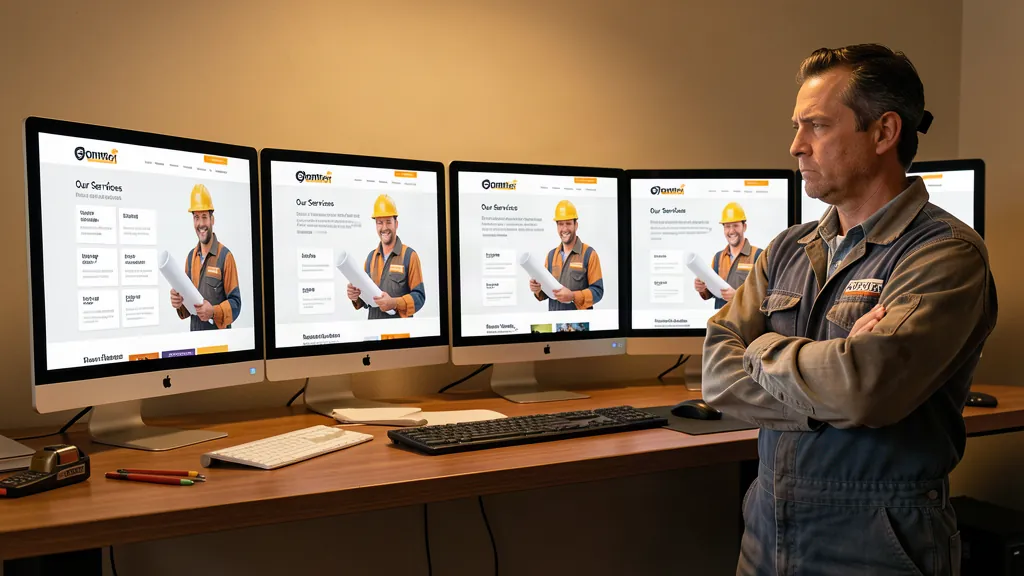
Let's be fair to the template. It's not evil — it's just generic by design. You picked a trade theme, typed in your company name, and got a site that looks like a business. That's the catch: it looks like every other business.
Here's what an off-the-shelf template actually does to your search visibility:
- It makes your business interchangeable. Your competitor two towns over used the same theme. Same layout, identical service icons, same stock photo of a smiling guy holding a blueprint. When a homeowner can't tell your real operation apart from the next listing, you get treated like a commodity.
- It buries your service towns in the footer. Templates force a rigid layout — Home, About, Services, Contact. There's no room for individual towns, so you end up dumping twelve of them into a tiny footer paragraph. The single most important filter for a local homeowner — where you actually work — gets tucked away where neither the search crawler nor the customer looks. The template gave the second most important thing you have a footer.
- It strips out local context. A pre-made theme doesn't know your housing stock, your regional building quirks, or your decades of local reputation. It forces your trade into generic boxes that never build local trust.
- It bogs down performance. Generic themes are packed with unused scripts, bulky page-builder code, and design extras you'll never touch. On a job site or a phone on the road, every extra second of loading is an excuse for a homeowner to back out and tap the next competitor.
Now here's the part that's easy to miss. This isn't a “templates are bad, custom is good” sales pitch. The core problem isn't aesthetic — it's architecture.
A high-performing site is structured around how you actually earn:
- Every primary trade gets a dedicated, focused page.
- Service areas are explicitly mapped and organized.
- Real proof and direct contact methods sit front and center.
A template is engineered to look like a generic website on a desktop screen. A high-converting contractor site is engineered to turn local search intent into booked jobs. That's the difference between a site that looks like a business and a site that gets you business.
We build sites the way they should be built for a trade: structured around what you do and where you do it, so Google understands your whole business in one glance and your towns actually get covered. Not a template with your name on it. A site built for the way you earn.
Want an honest answer about your website?
Run the free review — we inspect your live site and tell you where it's losing ground. Or tell us what you do and where you work, and we'll look at what's there.